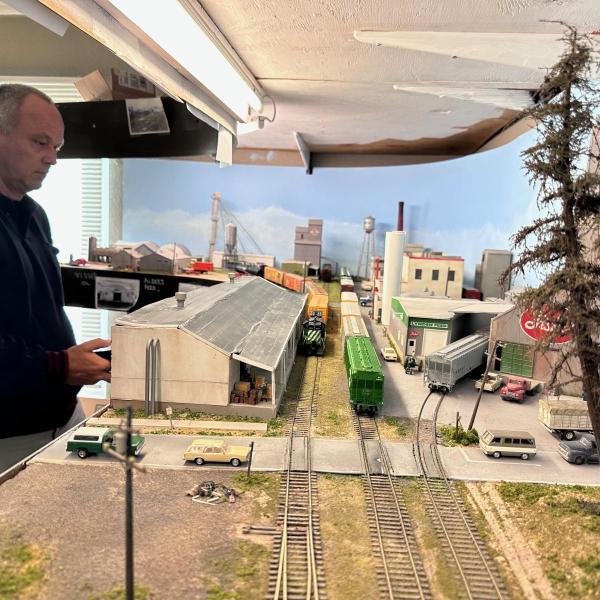
Chris Atkins Operations
Billings Assistant Yardmaster
Billings Switch Crew 1
Billings Switch Crew 2
Sugar Factory Local
Laurel Yardmaster
Laurel Yard Engine 1
Laurel Yard Engine 2
Laurel Yard Engine 3
Laurel Local
Huntley Turn
Transfer Engineer
Road Engineer
The layout is set in northern Wyoming and southeastern Montana. The top level is the Burlington Route from Sheridan, WY to the connection with the Northern Pacific mainline on the Yellowstone River at Huntley, MT and is mostly rural, open spaces. The lower level is where the Burlington has trackage rights over the Northern Pacific from Huntley to the city of Billings the large yard at Laurel.
Major industries served by the railroads in 1967 are coal mines, sugar beet factories, oil refineries, a meat packing plant, steel fabrication, flour mills, grain elevators and agriculture.
Construction began in January 2015 and about 1/3 of the track has been laid. The layout is housed in a 85' x 15' 1895 Texas and Pacific section house moved down the tracks from Roanoke. This is the second layout to be built in the section house.
2 level connected by a helix. Lower level Standard gauge Chinook Southern; upper level Chinook Southern and Poudre Valley 3ft. narrow gauge. Point to point. C.S. begins at Chinook yard and proceeds south to Frustration Flats yard. P.V. goes from Frustration Flats yard to Fairplay. Small steam engines with 36 and 40 foot freight cars traveling through Colorado mountains. Freelance.
The Midwest Terminal is a generic walk in, U shaped switching layout representing an industrial area branch line in a big Midwestern city. (rotating between Chicago, St. Paul, KC or others with different locomotives for each session).
Operations start from DIRTY (Downtown Industrial Rail Transfer Yard) and operators always begin their shifts “just after” the transfer trains from two major railroads have dropped off that day’s cuts of cars. One operator will classify in the yard and switch adjacent industries, including grain elevators, concrete plant, gravel pit and steel mill, while the other takes cars for various industries along the branch, including brewery, pipe manufacturer, cold storage, logistics center, newsprint supplier, Ethanol Terminal, Propane distributor, lumber, rail/truck transfer tracks and others. The branch operations are usually split into 3 distinct runs.
One side of the layout is the 7 track yard, and the other is loosely based on the track patterns of the famous N scale Kingsbury Branch by Bill Denton, adapted to Atlas Code 55 N Scale track.
Hard flooring, 4 foot aisle and layout height of 33-36” makes this a potential “roll around” layout for maximum comfort.
This layout was built, and is maintained with one thing in mind: Having fun operating a model railroad.
The WF Div FW&D is a point to point layout representing the FW&D between Ft Worth and Wichita Falls. All towns between these points a represented on the layout, albeit some are represented by name only. The layout has 11 switching locations with a total of 51 industries. 6 operators stay busy performing the duties of: Wichita Falls Yard Master, Bowie switcher, and 4 road operators. The layout is 98% sceniced.
Downtown – SP – 18 businesses – serviced daily by 22 car train
Old Town – WP – 16 businesses – serviced daily by 22 car train
Industrial Park – SC – 11 businesses – serviced daily by 14 car train
North Sacramento – LSI – 15 businesses – serviced daily by 20 car train
Yard and Docks – Sierra Lines Management – 11 businesses, 9 yard tracks with 200 cars capacity - serviced daily by 12 car train
East Sacramento – SP – 13 businesses – serviced daily by 18 car train and nightly by 9 car train
The Sierra Lines is an amalgamation of the Sierra Division of the Southern Pacific Lines (SP), the Virginia and Truckee River Railroad (V&T), and the Lodestone, Sierra, and Incline Village Railroad (LSI), the Western Pacific Railroad (WP), and the Sierra Central Railroad (SC), all put together and operated under the auspices of the infamous Dr. Arthur Smith, as you all know. The Texas version of The Sierra Lines all takes place within the city limits of Sacramento, modeled to represent exactly as it would have been on April 1, 1954, given that the long expected “big one” (earthquake) and two eruptions of the Toiyabe volcano had previously occurred. Rebuilding of much infrastructure of parts of the city is still in process, and many areas have no traffic lights, no sewer systems, and no water lines.
Potomac Valley lines is based on the prototype of the railroads along the banks of the Potomac River in the Eastern Panhandle of West Virginia. Railroads represented are the Baltimore and Ohio, the Western Maryland and the Pennsylvania RR. The railroad is set in the 1959 steam to diesel transition era prior to the Chessie system merger. The Eastern end of the Railroad is the Staging yard in Brunswick, Maryland. Trains bound for Baltimore, MD or Washington, D.C. end up here. The Western end of the railroad is the staging yard in Cumberland, Md. where B&O trains can be headed for Pittsburg, PA or any points west. There is a large yard at CUMBO, WV where many cars are interchanged between the B&O and PRR. There is also an interchange at Cherry Run, W.Va. with the WMRR. The branch line to the famous old resort town of Berkeley Springs, WV is modeled and has industry switching, the sand mine for Pa. Glass & Sand is also modeled. The PRR interchanges with CUMBO yard and switches most industries in Martinsburg, WV.
Towns modeled:
B&O RR: Brunswick, MD (East Staging), Martinsburg, WV, CUMBO, WV, Greenspring, WV, Hancock, MD, Berkeley Springs, WV, Paw Paw, WV, Cherry Run, WV, Cumberland, MD (West Staging)
WMRR: Cherry Run, WV, Big Pool, MD, Williamsport, MD
PRR: (Hagerstown, MD (staging), CUMBO yard, Martinsburg, WV
Specs: Benchwork: L-beam, Style: Folded dogbone, Roadbed: ½" plywood with cork, Track: Peco code 100 track, 26"r min, Turnouts: Peco Medium min. ,Grade: 2.25 max. Height: 45" to 53", Mainline run: 152'
Layout Status: Main line is finished, Branch line and sand plant at Berkeley Springs are finished, interchange to WMRR is finished but WMRR industries are under construction. CUMBO yard is finished. PRR interchange is finished and industries on the PRR is under construction and about ½ done. No ballast has been applied, only a few structures are in place and no scenery has been done. Turnout control for staging ladders is electric and automatic, but all other turnout are still manual.
The layout depicts the Erie, Buffalo Subdivision, from Buffalo (NY) to Salamanca (NY). The original Erie went from Dunkirk (south of Buffalo) on Lake Erie to Port Jarvis (NY) with a B&O interchange in Salamanca and an interchange with the Buffalo Pittsburg Line in Dayton (NY). After acquiring the B&P, Dayton still served as an Erie/Erie interchange and also the only tunnel on the Erie. The railroad represents heavy coal hauling to the steel mills of Lackawanna (NY) which were served by the South Buffalo RR and general freight and light passenger service for interchange with the primary east/west route of the Erie at Salamanca (staging). There is also a short line private RR (Conception and Viridity meaning beginning and always green) that interchanges to provide hardwood and limestone out of the Appalachian foothills of southern New York. 5 Operators: Yardmaster, Hostler/local service Engineer, road Engineer, Switcher/Short line operator and steel mill operations.
1-Run the boat train between Dewitt and the ferry boat yard, set out and pick up cars from the ferry boat, and return to Dewitt. After completion, join the crew for the Oneida turn.
2- Unload and load the ferry boat. After completion, join the crew for the Oneida turn.
3- Run the passenger train from Mohawk to Oneida, with stops at Tuscarora, Seneca, and Cayuga. After completion, join the crew for the Seneca and Cayuga turns.
4- Run the Seneca turn. After completion, join the crew for the Cayuga turn.
5- As the yard master classify, then block, three trains; handle returning trains; receive set outs from the NYC; send out cars to Dewitt. Run the Ottawa turn with the drill operator.
6- As the drill operator assist the yard master; operate the helpers; function as the NYC crew; run the Ottawa turn with the yard master.
As of June 1965, the Iroquois River Railroad (IRR), a wholly-owned subsidiary of the New York Central (NYC), remains operational. First and early second-generation diesel locomotives are in service throughout Upstate New York's Finger Lakes region. The NYC mainline extends between Selkirk (near Albany) and Buffalo (serving as eastern and western staging), with DeWitt yard near Syracuse functioning as a division point. While the NYC is largely prototypical, the IRR is a freelance operation, interchanging with the NYC at Mohawk and extending service through Tuscarora, Seneca, Ottawa, Cayuga, and terminating in Oneida on Lake Ontario.
The Mohawk interchange and the mainline to Oneida are currently modeled. The double-track NYC mainline is represented within the staging area, although DeWitt yard is not yet functional.
1956! Fictitious 200 mile stretch between Philadelphia and Pittsburgh with a 25 mile branch line into Johnson City, West Virginia. The branch line is served by the cities of Westbrooke, PA and Keyserton, PA.
Code 83 flex, 140 feet mainline with #6 and bigger turnouts and 22" minimum radius turns.
Missouri-Kansas-Texas (MKT) layout set in and around Waco, TX in the spring of 1987. Layout is a double deck with helix, fully signaled with ABS, and operates with JMRI. Layout is approximately 12x23 feet with a peninsula and 2 levels.
The Rocky Mountain Central (HO) and the Colorado Pacific (HOn3) are based on the D&RGW and the Colorado Southern in the mid 50s. Steam is still the primary motive power (most with sound). The layout features two large yards, a dual gauge interchange, logging operations, mountains that extend to the floor, laser etched control panels, and a unique benchwork design that allows easy access to under layout work.
Four railroads are involved in this operation which involves three interchanges. One operator will run the Crandic Interurban which involves switching Cedar Rapids, Iowa City and the Milw. Road interchange at Wausau. A Wausau yard operator who my also run the M&StL interchange and switching in New Ulm. Belle Plaine will require a yard man to work the set outs and pickups on the main as will as switch the industries. The fourth operator will run the Milw. Road branch out of Wausau to Plymouth which includes a turn with the Northwoods Hiawatha. A New Ulm turn will be run out of Belle Plaine by who ever is available. This session will involve a lot of switching using car cards and will consume approximately 3 hours.
The Chicago and North Western Iowa division in the Belle Plain area is the focus of this 15' x 35' foot railroad. Branch lines of the Milwaukee road and the Cedar Rapids and Iowa City are also represented.
Layout is a John Armstrong design heavily modified by adding more towns and switching and was featured in Model Railroad Planning. Many structures are still in the mockup stage. A great deal of recent effort has gone into making the railroad ready for operation.
Control is RailCommand with car routing by car cards and waybills.
Jobs include the Cedar Rapids and Iowa city yard and road Engineer; Wausau yard plus Plymouth Patrol; New Ulm turn out of Belle Plaine Engineer; Columbus Engineer out of Belle Plaine; and the Belle Plaine Yardmaster building and breaking down the above trains for main line set out and pickup at Belle Plaine industries.
Lloyd is a consummate craftsman well known for his detailed models and articles in the hobby press. He is also a C&NW authority and has authored four Volumes for Morning Sun Books on the Chicago and North Western in color as well as over 30 magazine articles.
Layout is upstairs in the house, located in a cul-de-sac, enter at the front door. Park anywhere on the street, without blocking a fire hydrant!
The GNW is a route between Duluth and International Falls, Minn. The modeled portion is the 1st division from Duluth to the fictitious town of Valley Ridge. Steep grades and big steam is the norm. Interchange is with NP and GN.
Mainline Size
100 ft
Era
1950's
ompletion
Track: 100%
Scenery: 70%
Electrical: 100%
Control System
CVP Easy DCC
The Texas and St. Louis Railroad is an operational layout having many jobs to make the railroad come alive. The layout is based on the history of the Texas and St. Louis (T&SL) which went into receivership in the late 1880's. The railroad emerged from bankruptcy re-branded as the St. Louis Southwestern Railroad. At one time it was the second longest narrow-gauge railroad in the United States. It stretched from East St. Louis, Missouri to Gatesville, Texas, all narrow gauge.
The railroad models the premise that the government would not allow the railroad to abandon service on some narrow-gauge routes, and therefore, narrow gauge steam could be found into the diesel transition era in mid America and East Texas. The layout is set in 1958. Motive power is primarily first-generation diesels with an occasional steam engine making an appearance.
The Texas and St. Louis layout currently allows for 6-8 operators with a dispatcher. All trains run extra with the exception of passenger service and the Blue Streak Merchandise. Construction on the layout began in March of 2019. Scenery is roughly 90% complete at this time. The trains are controlled by NCE DCC. The pike uses JMRI for dispatching and car inventory. Currently the narrow gauge is not in service pending additional expansion which should be completed by June of 2023. There is a 10-track staging yard that represents Texarkana and points north. Trains arrive and depart Tyler yard where they are broken down and reassembled for departure and dispatched across the railroad south and west.
The MCIS St. Clair Subdivision is a 13'x12' double deck shelf style HO scale layout. Representing the eastern end of this modern Michigan regional, the "Clair" sees a variety of daily trains including manifest, local, and unit. Constructed in 2011 the layout is now 60% sceniced and fully operational. Utilizing two staging yards, a 3.5 turn helix, and on-layout classification yard the layout hosts a lot of railroading in a small space that will keep crews busy around the clock.
The Dakota Northern is a Burlington Northern subsidiary inspired by the Great Northern line between Grand Forks and Minot, North Dakota. Focus of the layout is Devil’s Lake, North Dakota. In addition to the BN, The Soo Line also has operating rights in the area. Local switchers contend with heavy movements of agricultural traffic on the main line, particularly grain moving to Duluth and the Twin Cities. Era is 1975. Built for operation, the Dakota Northern is 12 x 13.5 feet. Scratch built structures are a favorite part of the hobby to Olaf and many structures in and around his hometown of Devil’s Lake are represented.
12' x 13.5' with an 2' x 8' extension
Modeling the north and western portion of the Namibian TransNamib railroad. From the port city of Walvisbaai, where the majority of products are imported and exported, up to Tsumeb and Grootfontein in the north, as well as the main line to the capital city Windhoek with a hump yard.
The track plan is a three leg star with Kranzberg in the middle (at the bottom of that Helix shown on NMRAx) with two staging yards, first one beyond Walvisbaai at the ocean on the "west" end and the main staging yard south of Windhoek in Keetmanshoop on the "east" end. Going up the Helix is the north leg which splits at Otjiwarongo to Outjo and north to Otavi and Grootfontein. Track to Tsumeb had not passed Namibian Track Authority tests yet.
Operators need to be able to read N scale car numbers, the last 3, at least and recognize car types and colors. Each operator will either start or end operating a yard and spend the other half of the session running and switching a freight train to or from that yard.
Layout is upstairs, enter the front the door. Park anywhere on the street.
*** A headset with a microphone is required, with the Zello App installed on your phone.
Based on the CB&Q Fox River branch from the Eola yard (staging) in Aurora, Illinois to Streator, Illinois. The layout is set in October of 1954 and is based on prototypical operations. The other railroads that the CB&Q crosses are active and modeled including the CRI&P, Wabash, GM&O, Illinois Midland, and ATSF. Silica Sand is the primary commodity and reason for the railroads existence. Two large glass factories and a large fertilizer factory keep traffic moving along with the usual granger road commodities of corn/soybeans/coal/oil/lumber. This layout is all switching with eight jobs.
The HO scale Gulf Lines is a model of the Santa Fe Railway in Dallas in 1960. Actual Santa Fe plans have been used to accurately depict the railroad from mile post 44 in Oak Cliff, through East Dallas Yard, to mile post 53.4 near the Texas State Fair Grounds. Selective compression reduces this mainline to approximately 250 feet or about four scale miles. The layout is single decked with wide aisles. Three large staging yards represent Cleburne, Gainesville, and Dallas Union Terminal.
The layout is located on the second floor in a purpose-built room above the garage. Enter through the front door and up the stairs. The layout is not accessible to those who are mobility impaired.
Operators having any level of experience are welcome to contact us for an invitation to participate in an operating session. Please note, however, that most switch jobs will handle dozens of cars to be spotted as well as dozens of cars to be picked up at several industrial zones. Yard crew members will classify up to 200 cars in each yard during a single operating session. Operations on the GCSF run much more smoothly when the crew members have significant operating experience.
For those operating with us during the NMRA National Convention in August, 2023, please note that the sessions will begin at 5:30 PM. Please plan to arrive at the layout by 5:00 PM for orientation. We will operate for about 90 minutes, then break for dinner, which will be provided. Please have cash available to contribute to the cost of the meal. Operations will resume after the dinner break and should conclude by about 10:30 PM. The layout is only a 15 minute drive from the convention headquarters hotel.
2. Road Engineer1-minimal experience operator
2. Road Engineer2-minimal experience operator
Proto freelance -West Texas locations.
Layout built by father and son. Air-conditioned room.
I model a freelance railroad that interlines with the Nickel Plate Road. The layout is mostly one level with 3 main yards and can handle up to 4 operators at a time. I use Wheel Reports as an operation mode for operators . The layout is set in the transition period of the 1950/60’s and is based in Ohio. The main yards are Conneaut, Fostoria, RVEX and operators work from these yards. The operation jobs are Fostoria yard master, Fostoria hostler job, Conneaut Yard master and operator, RVEX Yard master and Operator.
The upper track services the town of Ashtabula and is a local turn run requiring the use of the wye to turn the train and engine for return.
My layout is a good one for beginners but any level are welcome.
The Lake Troy District Railroad is an HO scale fictional, regional-sized subsidiary of the Southern Pacific that exists somewhere in the approximate Midwest of the USA. It doesn't model any specific prototype, but does move a wide variety of freight, including coal, grain, refrigerated products, express, and TOFC intermodal. The layout is envisioned as being multi-era, with equipment and power representing 1962, and additional equipment and power representing 1971. The hope is to also allow the layout to represent 1981, with equipment and power that model that era as well. It's ambitious, but I think it's do-able, and will satisfy the layout owner's desire for having a reason to model multiple generations of diesels starting with the end of the transition era and going up to the timeframe just before cabooses were deemed unnecessary. (The LTD Railroad likes it's cabooses!)
The layout was previously fully operational, but recently about 1/3 of the layout was torn down and is being rebuilt/redesigned to accommodate better operating activities. The redesign will not only make operations better, but will also add about 25% more railroad in the same footprint.
Switching is the main task on this layout, and most trains (even some of the passenger trains) do at least a little switching. There's not much scenery yet, however the trains will soon be running and local industries in the five main towns need their shipments of goods. We also interchange with two other foreign roads.
In addition to the local trains that service each of the five towns, there's also a Coal Train that services the local power plant and makes dropoffs and pickups at various towns and switches the coal tipple. As well, there's a separate reefer train (ice bunker and/or mechanical refrigerator cars depending upon era), a daily express train (the Super Express), at least one TOFC intermodal train, and a couple of passenger trains. And that's a lot of traffic for a single-mainline railroad.
Novice operators are not excluded (they're welcomed), however operators with at least some experience are encouraged.
Because of the eras being represented, steam is obsolete and all power is diesel. In 1962, road power is mostly first-generation diesels, with a heavy emphasis on Fairbanks-Morse and Alco road switchers, and FM and EMD cab freights, with a few Baldwins thrown in for variety. In 1971, many early diesels are gone and replaced with locomotives from Alco's recently introduced Century Line of road power. The Lake Troy District Railroad has invested heavily in these revolutionary second-generation locomotives, but is also diversified with a good representation of GE's Universal line of diesels. By 1981, all of the remaining first-generation locos have been retired and replaced with EMD's new 4-axle GPs and 6-axle SDs.
If you like switching, you may just enjoy the LTD!
The Utah Belt – Northeast Sub is a completely fictional HO scale layout inspired by years of living near railroads, with creative influence from model railroading experiences, including insights from Eric… Spanning a modest 10’x19’ space, the layout features a variety of industries, many reflecting my professional background in food and heavy manufacturing. It is fully CTC signaled and includes three towns and one city, complete with street running. The layout’s signature challenge is a steep 3% grade known as Incline Run, which requires speed-matched DPU’s on the rear of all ascending trains. A spacious 6-foot-wide main aisle adds to the fun, offering ample room for movement and camaraderie.
Era and Equipment: Set in the late 20th century, the layout operates EMD units, including GP and SD locomotives. All non-revenue equipment, such as engines and cabooses, are custom-painted in the distinctive Utah Belt livery with sound and full lighting packages. The revenue fleet consists of a diverse mix of cars from various railroads and lease companies, providing operational flexibility and enhanced service options for the industries served.
Mission: My goal is to inspire more professional modelers to dive into this rewarding hobby. While I am looking to expand the layout in a new space soon, its current size demonstrates that realistic, operation-focused modeling is achievable for anyone, even my friend Mark!!!
System and Control: The layout is DCC-operated and BYOT (bring your own throttle), though engines and rolling stock are provided. WiFi supports apps like WiThrottle, and other WiFi based throttles, enhancing operational flexibility. The control system is Digitrax, with block isolation, detection, and signaling managed through JMRI and mqTrains RF modules thanks to Speed Muller! Locomotives are equipped with realistic momentum and brake settings. Mainline turnouts are remotely operated using throttles, with most industry spurs manually controlled for a hands-on experience.